
San Diego County Wanted Releases
The San Diego County Sheriff's Office does not publish a fixed-count, comprehensive most-wanted gallery. Its official media and news list instead carries selected wanted notices and Crime Stoppers releases when investigators seek public help. A release may include a photograph, a case summary, identifying information, and a request for tips. Publication is episodic. The Sheriff gives no set posting cadence, and no verified recurring “Warrant Wednesday” feature was found. A cold-case page may also show faces, but it is not a current most-wanted list.
This distinction matters. A person may have an active adult criminal warrant without appearing in a photo-bearing news release. Conversely, an older release may remain findable after the status has changed. The official warrant database is the better place to check a name. The news list is the better place to see cases the Sheriff has chosen to highlight. Neither source should be read as a finding of guilt, and neither replaces the issuing court's file.
The publication systems also cover different stages. A wanted person may still be at large and have no county booking record. A person arrested on the warrant may later appear in Who's in Jail while held by the Sheriff. After release or transfer, that current-custody entry may disappear even though the warrant arrest and court case still have records. The California Department of Corrections and Rehabilitation search applies only after a state-prison commitment, not to a person wanted or newly booked on a county matter. Keeping those stages separate prevents a missing result from being given the wrong meaning.
San Diego County Wanted Fields
Wanted releases are written for a specific investigation, so their contents vary. The standard San Diego County warrant record is more uniform. It can identify the person and the court command without displaying a face. Read each value as a lead for verification, not as a complete criminal case history. A last address may be old, a charge may appear as a code, and a physical description may not be current.
| Field | What it shows |
|---|---|
| Name and birth date | Core identity details used to separate people with similar names. |
| Physical descriptors | Sex, height, weight, eye and hair color, and race or ethnicity when listed. |
| Last address | The address held in the warrant record, which may no longer be current. |
| Warrant data | Warrant number, type, issue date, issuing court, and court appearance field. |
| Alleged offense | Primary charge code, crime type, and any bail amount stated by the record. |
| Photo or case summary | Possible in a selective wanted release, but not a standard warrant-search field. |
The absence of a photo is expected in the warrant system. San Diego County generally withholds routine booking photographs. The Sheriff's published exception is an immediate public-safety need, which helps explain why a selected wanted release can carry an image while an ordinary warrant result does not.
A warrant detail can list bail and a court appearance field, but it is not the court docket and should not be used to predict release. The issuing court has the case file. The Sheriff's office has the warrant repository and the public search. If the name, birth date, or descriptors conflict, stop and seek official confirmation instead of combining records from two people. Common names make this check especially important.
Note: A San Diego County warrant record has no standard photo field, while a selective public-safety release may include an agency-held image.
Use San Diego County Wanted Notices
Read every wanted notice at its official source. The Sheriff's office controls what shows up there. It picks the photo, decides which details to share, and sets the route for tips. Context counts for a lot. A cropped screenshot on social media drops the case facts that give a notice meaning, so never pass one along on its own. Match the name and case details to the person you have in mind before you act. Then report through the tip route the agency lists, not a shortcut of your own.
- Open the Sheriff's media list and select the wanted or Crime Stoppers release itself.
- Read the full notice, including the date, agency, alleged conduct, identifiers, and any safety warning.
- Compare the release with the official warrant database when a warrant check is relevant.
- If the person is now in custody, use the San Diego County custody and booking lookup to check the current Sheriff roster.
- Send useful facts through the Sheriff warrant line, official tip form, or Crime Stoppers. Do not approach or attempt detention.
Spotting someone on a custody roster tells you one thing only: the person is currently held by the Sheriff. Nothing more. A name that comes up empty has plenty of harmless explanations. Pre-booking delays, transfers, releases, and spelling variations all hide results, and some wanted individuals simply have not been picked up yet. For the straight answer, the San Diego County warrant search takes a name and returns matches directly from the county system.
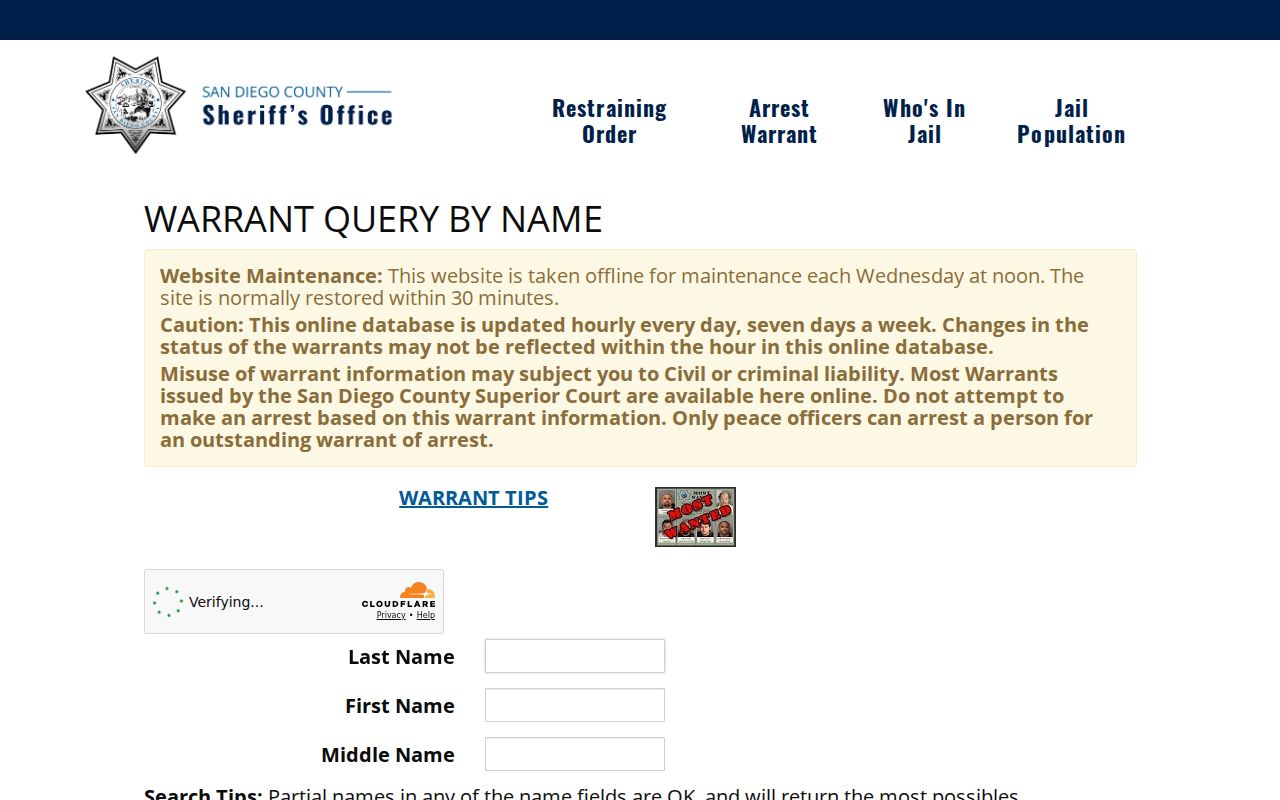
The search screen starts blank by design. Photos and personal details stay on the government side until a name is entered, and that empty box is where a careful check begins.
Safety: Never approach, follow, confront, or try to arrest a person shown in a San Diego County wanted notice. Give the information to law enforcement.
San Diego County Wanted Tips
Two local channels exist, and each has its own job. Call the Sheriff's warrant line when your information connects to an outstanding warrant. San Diego County Crime Stoppers is the better fit for anonymous tips, and some public releases dangle a reward for the right information. Don't count on that money, though. Rewards are case by case, so treat one as real only if the current release says so. Facing an emergency or an immediate threat? Skip both channels and call 911.
San Diego County Sheriff Warrants
858-974-2327
Use the official contact for warrant information or a case-specific tip.
San Diego County Crime Stoppers
888-580-8477
Anonymous tips are accepted. Rewards may be offered in selected cases.
A good tip sticks to facts. Name the release or warrant involved, describe exactly what you saw, and say where and when it happened, plus how fresh the information is. Leave the detective work alone. Investigators can weigh identity and risk using files the public never sees.
Note: Crime Stoppers takes anonymous reports while the Sheriff warrant line is separate, and a reward exists only when a release offers one.
Check San Diego County Warrants
Want to check for an outstanding warrant? The Sheriff's Online Warrant Information database is the place to start. It lists most adult criminal warrants issued by San Diego Superior Court. Coverage is broad, but not complete. You can search with a full name, or just a first and last name, since partial searches work too. The system refreshes every hour, around the clock, though results can lag a bit within that window. Expect a short maintenance pause around noon on Wednesdays.
- Enter the most complete name available. Try a supported partial-name search if spelling is uncertain.
- Compare the date of birth and physical description before treating a possible match as the same person.
- Record the warrant number, type, issue date, issuing court, and appearance information.
- Use the San Diego Superior Court source or an attorney to confirm the court file and current status.
- If the warrant may concern you, arrange a safe response through counsel or the issuing court. Do not rely on informal paperwork alone.
Want something more formal than a screen result? The Sheriff's SO-110 Service Request Form includes a warrant-check request option. You can also call Records & ID at 858-974-2110. Or visit the John F. Duffy Administrative Center at 9621 Ridgehaven Court in San Diego. Have identifying details ready, since they help staff pull the right file. The San Diego Superior Court Index offers another angle. Find the related adult criminal case there, then ask the clerk's business office for the official record.
One thing to understand. The Sheriff stores warrant data but does not control the court file. Showing up with paperwork will not get a warrant recalled. Only the issuing court can take that step. A matching name is just a starting point, so confirm it before drawing any conclusion.
Note: The warrant database is the only local system here with a stated hourly refresh, and that schedule does not carry over to custody records.
San Diego County Warrant Types
Search results sometimes name the warrant type. The full court file tells the real story. An arrest warrant directs police to take a named person into custody over a criminal matter. Bench warrants work differently. A judge typically issues one after a missed court date or an ignored court order. Other labels show up as well. If a code's meaning is unclear, look it up rather than guess.
| Type | What it generally means | Safe next step |
|---|---|---|
| Arrest warrant | A court command authorizing arrest in a criminal matter. | Confirm the number and issuing court through counsel or the court. |
| Bench warrant | A judge's warrant often linked to a missed appearance or court-order issue. | Ask counsel or the issuing court how to address it. |
| Other coded type | A category shown in the official record that may need court-file context. | Use the warrant number and request an official explanation. |
If the search shows a bail figure, treat it as a data field. It is not a guarantee of release. Court actions, holds, and the facts of the case all shape what happens after an arrest. The court and the custody agency in charge hold the only reliable answers on the current process.
Resolve a San Diego County Warrant
Think a San Diego County warrant has your name on it? Contact an attorney or the issuing court rather than trusting third-party claims. The public database is informational and can lag behind reality. When you ask for confirmation, bring the exact name, date of birth, warrant number, and court shown in the result.
After a warrant arrest, the person may show up in Who's in Jail once Sheriff intake wraps up. That can take a while. The court record is where the case's path lives, from arraignment through filed charges to the final disposition. Disposition simply means how the case ended, whether by dismissal, plea, trial verdict, or another ruling.
Where does the booking happen? San Diego Central Jail handles much of the central-county male intake, but the county runs several booking sites. Vista books both men and women in North County. Las Colinas is the women's facility. Placement can shift after intake, so check Who's in Jail for current location instead of assuming from the arrest site.
A few apps deserve a mention. The county has no Sheriff custody or mugshot app, and JoinSDSheriff is a recruiting tool, not a warrant checker. VINE/VINELink sends custody-change alerts once someone enters a supported system, but it cannot publish wanted photos or resolve a warrant.
For updates, go back to the source. Prosecutors can amend or drop a booked charge, judges can address warrants, and cases end in dismissals, pleas, or trial results. An undated copy of a release may be stale. Reopen the official notice, rerun the warrant search, and verify the court file, since the current government record always controls.