
Where San Diego County Crime News Appears
Official channels come first, though they answer to their own priorities. The San Diego County Sheriff's Office posts selected incident, wanted, and Crime Stoppers releases through its media news list. Those notices follow cases. They are not a daily booking feed. Social posts, Nixle alerts, newsletters, and public-safety bulletins serve narrower purposes and never add up to an arrest archive. Calls for service are dispatch events. Many never produce an arrest, so treat them as leads rather than booking records.
Local journalism fills in much more, one story at a time. Times of San Diego keeps a busy countywide crime stream. The San Diego Union-Tribune handles daily public-safety coverage. NBC 7, ABC 10News, CBS 8, and FOX 5/KUSI chase developing police, court, and jail stories across the region. Patch runs frequent items plus a roughly weekly San Diego County Crime Log. East County Magazine and the San Diego Reader round things out with neighborhood depth. None of these is a complete mugshot archive.
One local habit stands out: there is no dominant newspaper gallery of booking photos here. Every image is chosen for the story at hand. A report might carry police video, a shot of the scene, evidence, courthouse art, or an agency handout. That mix works well for following events. It cannot tell you who was busted countywide on any given day.
San Diego County News Outlets
Every newsroom keeps its own rhythm and photo habits. The table splits official releases from independent journalism and unofficial record aggregators. "Selected" means an image shows up only when it suits a particular story. It does not mean the outlet posts a face for every arrest.
| Outlet | Coverage | Photos? | Where |
|---|---|---|---|
| San Diego County Sheriff | Selected incidents, wanted cases, and public-safety releases | Selected agency images | Official news list |
| Times of San Diego | Countywide crime, courts, and public safety, often several items on active days | Story-specific | Crime |
| San Diego Union-Tribune | Daily police, jail, prosecution, court, South County, and North County reporting | Staff, file, scene, or agency images | Public Safety |
| NBC 7 San Diego | Continuous local broadcast and digital crime and court news | Video stills, scenes, surveillance, occasional suspect image | Local News |
| ABC 10News / KGTV | Daily city, South Bay, North County, and East County reports | Newsroom or credited official visuals | Local News |
| CBS 8 / KFMB | Daily or near-daily arrests, investigations, and court coverage | Scenes, documents, surveillance, or handouts | Crime |
| FOX 5 / KUSI | Countywide crime vertical on active news days | TV, staff, and agency material | Crime |
| San Diego Patch | Frequent stories and a roughly weekly county crime log | Usually scenes, operations, or evidence | Crime & Safety |
| East County Magazine | Periodic East County crime beat coverage | Article-specific | Crime Beat |
| San Diego Reader | Irregular neighborhood reporting and deep archives | Varies by contributor and source | Neighborhood News |
The Patch Crime & Safety section is a working example of the county's recurring crime-log format.
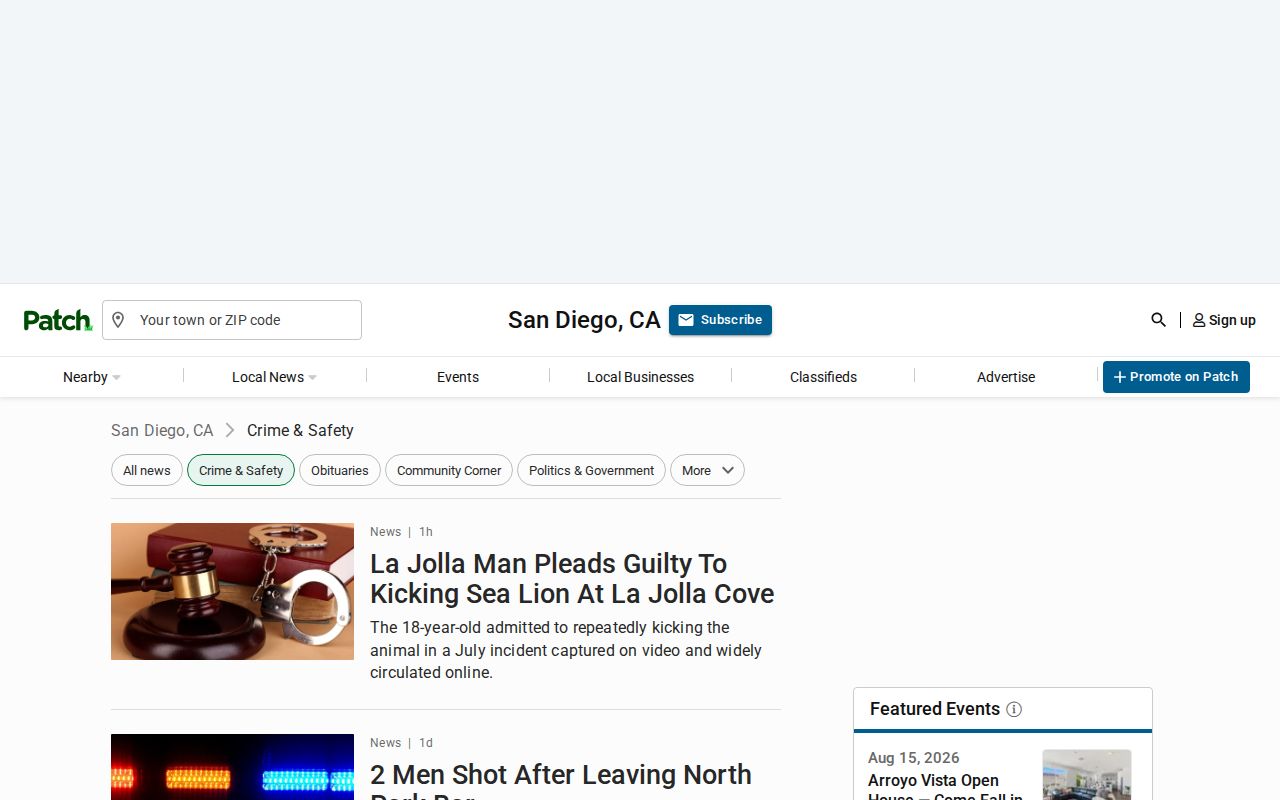
It documents a genuine local news route. Even so, its stories and images stay editorial picks rather than the official San Diego County booking record.
How San Diego County Photos Reach News
A routine booking photo is not an automatic roster field in San Diego County. The Sheriff's Media Guide lists photographs and booking photographs as non-releasable. One narrow exception exists. An image may go out when it helps capture or warn the public about a dangerous wanted person still at large. A separate Sheriff statement echoes that, allowing booking photos only for an immediate public-safety threat. That explains a common split. A wanted notice carries a face. Who's in Jail lists custody, charges, court dates, and a projected release date, but no ordinary intake photo.
Newsrooms get images through other doors. An agency may release one proactively, answer a press request, or supply surveillance footage for identification. Prosecutors, courts, and the outlet's own reporting fill the rest. The caption or story should name the source when known. California Penal Code § 13665 adds another limit. It restricts law-enforcement booking photos on social media, especially in suspected nonviolent cases, and calls for timely removal unless an exception applies. None of this turns the Sheriff's website into a photo archive.
The type of photo matters during a fact check. A surveillance frame can predate an arrest. A wanted image may target someone not yet in custody. A scene photo says nothing about identity. Even a genuine agency booking photo only marks intake.
Note: The caption and its source often reveal more than the picture itself, particularly when the report leans on a file photo or police handout.
From San Diego County Story to Record
A news story freezes what reporters and agencies knew on publication day. The official record lives elsewhere. It is split across the arresting agency, the Sheriff's current-custody system, and the Superior Court. Start with the story's agency and date. Then walk the record sources in order, watching for updates, releases, transfers, and changed charges along the way.
- Note the full name, incident date, city, arresting agency, and any case or booking number in the story.
- Check the San Diego County roster and booking-record path if the person may still be in Sheriff custody. A missing result is not proof that no arrest occurred.
- Request the arrest report from the city police department or Sheriff office that created it. Use the booking number when known.
- Use the San Diego Superior Court Index to locate the case by party name, court case number, or District Attorney case number.
- Inspect or request the official clerk file for charges and disposition because the free index does not provide either field.
"Disposition" is court language for how a case ends or currently stands: dismissal, plea, trial result, or another action. Charges filed by prosecutors can differ from those listed at booking. A person can drop off the current-custody roster while the case marches on. So follow the path all the way to the clerk file instead of stopping at the first headline.
San Diego County Has No Booking Feed
San Diego County publishes no 24-hour, 48-hour, 72-hour, or weekly booking feed. Nothing on the official jail pages fills that gap. Open-data portals and public-information paths do not either. The Sheriff's Who's in Jail tool only searches current custody by name, so anyone released before you look will not appear. Chula Vista posts a temporary city holding list. That narrow snapshot is not a countywide arrest record either.
News releases pick and choose incidents. They never cover the full booking picture. Calls for service log dispatch activity, not arrests. So a newsroom roundup and the official roster can disagree without either being a complete daily list.
Missing someone from current custody? Work backward. Try the arresting agency's report process first. If the Sheriff holds the booking record, its Records & ID Division is the next stop. The court file follows. San Diego, Chula Vista, and Oceanside each run their own police records desk before a case enters shared county custody and the courts.
Facility geography helps too. San Diego Central Jail is the main central-county male intake site, not the only destination. Vista handles North County intake for men and women alike. Las Colinas holds women. A state prison sentence moves the person into a whole new system, searchable through the California Department of Corrections and Rehabilitation CIRIS search, which posts no booking photos and is not a county source.
Note: A person can pass from city processing to Sheriff custody and then to court or state custody, so the right search source shifts over time.
San Diego County Crime Log Pattern
The strongest clean daily stream usually comes from Times of San Diego. It posts multiple crime, court, and public-safety items on busy days. TV stations jump on breaking stories fast, often with video. Patch runs its San Diego County Crime Log on a roughly weekly rhythm, frequently on Fridays, and those roundups can reach from San Diego to Oceanside and beyond. The Union-Tribune carries court coverage that outlives the first arrest headline.
Geography shapes what you see. Chula Vista cases surface in South Bay coverage. Oceanside sits in the North County streams. East County Magazine keeps a regional crime beat outside the three biggest cities. The Reader sometimes preserves neighborhood detail and older stories, though its contributors vary. For the county seat itself, the San Diego busted mugshots record path helps separate SDPD reports from Sheriff custody records.
Do not confuse volume with completeness. A flood of posts may just mean one big case or a loud news cycle. A quiet page says nothing about arrest totals. A weekly roundup skips plenty. Official agency and court records stay the final control sources.
Unofficial San Diego County Arrest Pages
Third-party sites belong after the Sheriff, police, and court routes. Never before them. Local Crime News maintains a San Diego County Sheriff agency page with daily updates listing names, ages, reported city or county, dates, and charge statutes. It leans on text, not photos. So it is not a good mugshot source. Watch the city label too, since it may mark where a person lives rather than where the arrest happened.
The captured Local Crime News county page documents only the secondary information landscape.
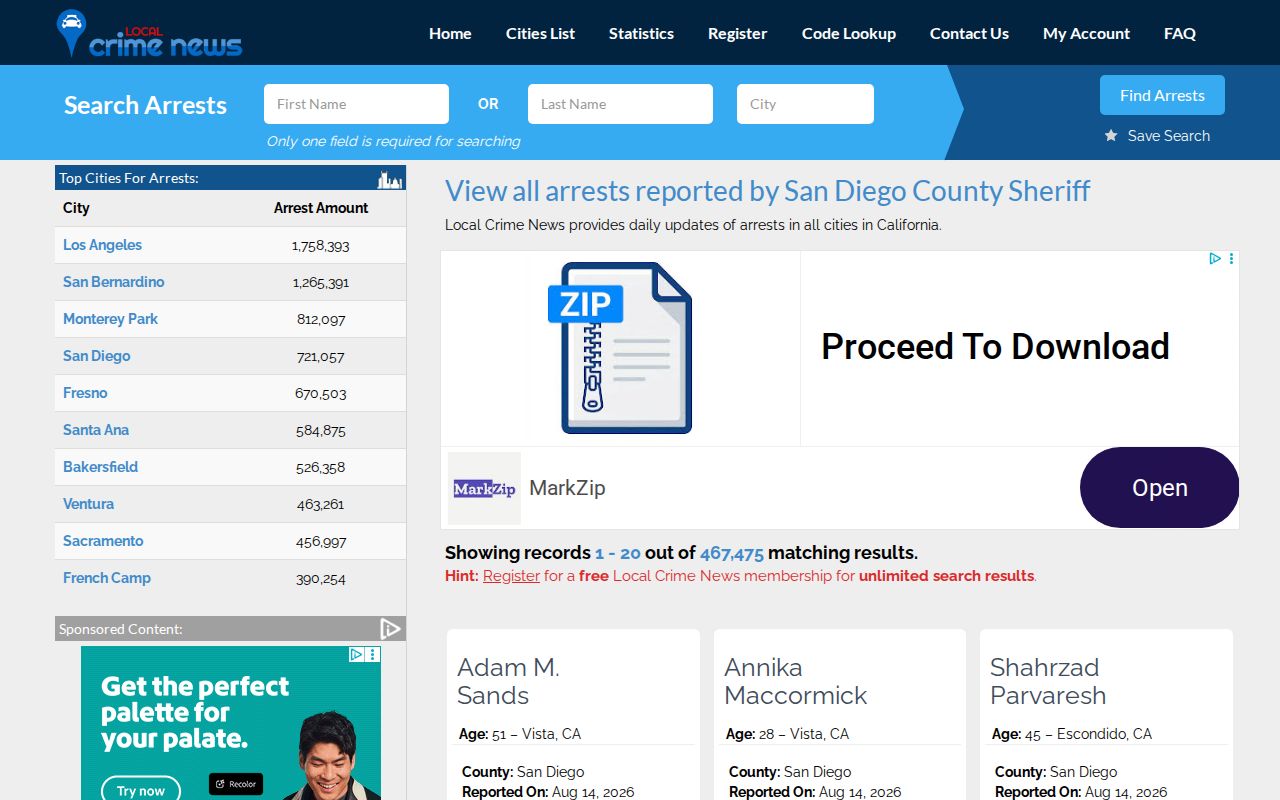
Entries there can be delayed, incomplete, or simply wrong. Every name and charge needs confirmation through the San Diego County Sheriff and Superior Court.
Mugshots.com does hold a verified San Diego County page. But its visible year filters stop at 2016. Treat it as a stale historical archive, not recent crime news. The site shows photo thumbnails with locality labels for San Diego, Chula Vista, and Oceanside. None of that reflects current custody.
The captured historical Mugshots.com county page carries that strict limitation.
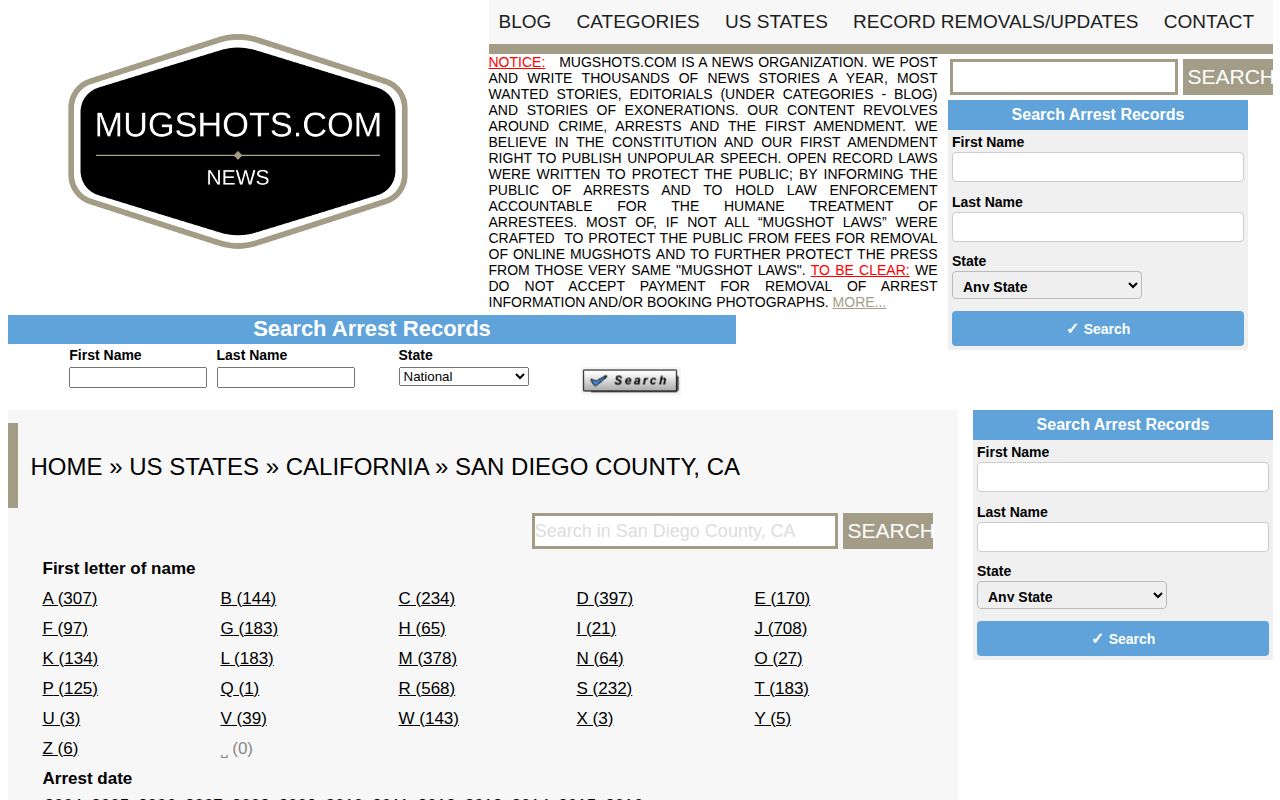
The capture simply shows what the old index looked like. It is not a current-arrest record.
Busted Newspaper, RecentlyBooked, Arrests.org, and Mugshots.zone had no verified current San Diego County section. A guessed URL is not local coverage. Neither is an item about a San Diego resident booked in another county. Provider inventories shift over time. The safe rule holds regardless: check any unofficial result against the originating agency and the court disposition.
Note: Unofficial indexes can keep old names and images long after custody changes, so their dates and claims need a fresh official check.