
San Diego County Busted Mugshots
A booking photo starts with an arrest. Somewhere between the street and the cell, fingers get printed, a record gets typed, and a camera captures a face. The agency that makes the arrest is often not the agency that runs the jail. City departments like San Diego Police, Chula Vista Police, and Oceanside Police write their own arrest reports. The county's jails belong to the Sheriff's Office. Men are booked mainly at San Diego Central Jail, Vista Detention Facility takes both sexes in North County, and Las Colinas holds women. Classification, medical needs, and bed space can all shift where a person lands.
That split shapes any search for San Diego County busted mugshots. An arrest report describes the event itself. A booking record covers intake and current custody. The photo serves one purpose: identification. It is not a routine field in the Sheriff's online roster. Once prosecutors file, the court case takes over, tracking arraignment, hearings, and how everything ended. Each record answers a different question. None of them substitutes for the rest.
San Diego County Booking Record Fields
No single document holds a full booking record in San Diego County. Who's in Jail shows who is in custody now. Records & ID handles older Sheriff bookings. The arresting police department keeps its own report, and the court file picks up the story once charges are filed. California Government Code § 7923.610 adds another layer. It requires disclosure of certain current arrest facts unless release would endanger a person or an active investigation.
| Field | What it shows |
|---|---|
| Name and booking identity | The person attached to the intake record; a booking number helps distinguish similar names. |
| Arrest and booking details | Dates, times, arrest location, arresting agency, and factual circumstances when disclosable. |
| Custody location | Present Sheriff facility or release time and manner when available. |
| Booked charges and holds | Charges, warrants, probation or parole holds entered during intake. |
| Bail and court date | Bail information and the next scheduled appearance when known. |
| Projected release | An estimate when known; the Sheriff warns that recalculation can make it inaccurate. |
| Booking photograph | An intake image that SDSO generally withholds from routine public release. |
Booking photos sit outside that mandatory list. SDSO treats ordinary images as exempt investigatory material under Government Code § 7923.600. A careful request can still list the record and the photograph as separate items. It just can't promise the photo will come out.
Note: A booking number is useful for a records request, VINE registration, and separating people who share a name.
San Diego County Booking Record Requests
A booking that leaves the current roster starts with the SDSO SO-110 Service Request Form. Identify the record several ways. A name and birth date works. So does a case number, a booking number, the arresting agency with a date, or plain incident details. The form can return a local history, custody letter, warrant check, or case report.
One catch deserves attention. There is no photo checkbox. Write "booking record" and "booking photograph" on the "Other" line as two distinct items. That way the office processes each on its own footing.
- Confirm the arresting agency and gather the name, date of birth, arrest date, case number, or booking number that is known.
- Describe the sought record narrowly. State whether the request is for an arrest report, county booking record, custody letter, or booking photograph.
- Email a booking or local-history request to
Booking.Records@sdsheriff.org, deliver it in person, or mail it to the Records & ID Booking Section. - Provide required identification for a requester's own local history. Pay only a fee the agency states for the actual record.
- Read any partial-release or denial letter. A photo request remains subject to the Sheriff's no-routine-release policy and the cited exemption.
San Diego County Sheriff's Office, Records & ID Division
John F. Duffy Administrative Center
9621 Ridgehaven Court
San Diego, CA 92123
Records: 858-974-2110
Monday-Friday, 8:00 a.m.-4:30 p.m.
Closed noon-1:00 p.m., weekends, and holidays
Booking Section mail:
P.O. Box 939062
San Diego, CA 92193-9062
Fees trip people up here. The published $14 charge covers one thing: a requester's own SDSO local criminal-history report. Paying by credit card adds $3. No price for a Sheriff booking photo has been published at all. Timing works differently too. The form says requests normally process within ten calendar days, while the California Public Records Act gives agencies ten days to make a determination, extendable for unusual circumstances. Neither deadline promises delivery of the record itself.
California Busted Mugshot Law
California treats arrest facts and face images as two separate doors. Government Code §§ 7923.600-.610 keep an investigatory-file exemption on the books. Even so, they force disclosure of specified contemporaneous facts in many cases. SDSO leans on that split. Useful custody and arrest data goes out. Routine booking photographs generally stay in. Penal Code § 13665 takes a different angle, limiting how law enforcement can use booking images on social media, with special protection for suspected nonviolent crimes. Its fourteen-day removal rule applies to social posts only. It says nothing about jail rosters, agency files, or publishers.
Money is the third rail. Civil Code § 1798.91.1, the state's anti-pay-to-remove law, bars a booking-photo publisher from soliciting, requiring, or accepting payment or anything of value from the photographed person to remove, correct, alter, or withhold the image. Civil remedies exist under the law. It does not force every independent publisher to erase every accurate record, though. The practical rule is simple: never pay a publisher or a middleman. Use free correction routes and court relief instead. The official Civil Code source shown below contains the statute itself, not any mugshot or commercial listing.
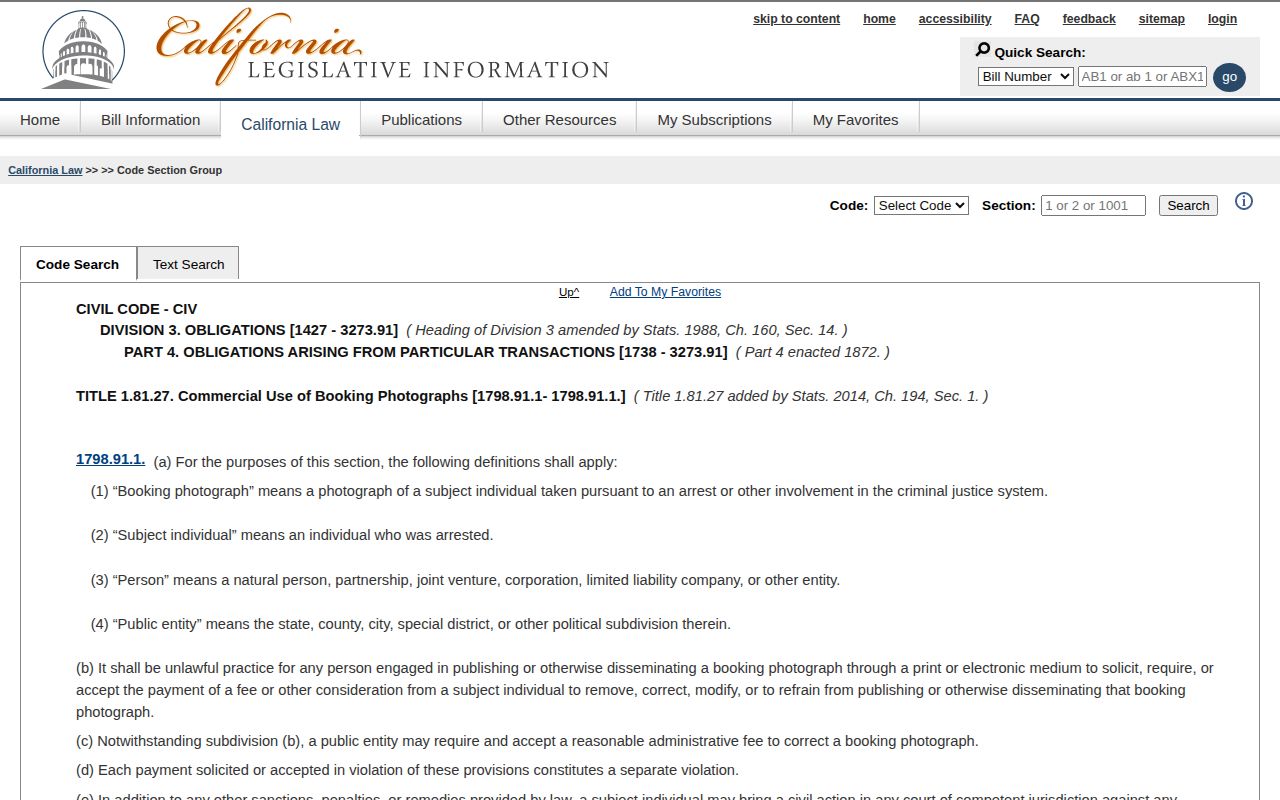
The statute backs the no-payment warning. Fixing the underlying item takes another route: an agency correction, a sealing order, or a publisher's free process.
Free Busted Mugshot Corrections
No single switch removes a San Diego County mugshot. Start at the source. For an SDSO error, a focused Records & ID request should name the booking number, the exact field, and the corrected fact. For a third-party page, save the full URL and use the publisher's own free correction or removal channel. Send only what the stated policy asks for, such as a filed sealing, dismissal, mistaken-identity, or other qualifying order. Extra identity documents just create risk.
- Mugshots.com publishes a free record-maintenance process for several court-backed outcomes, though its San Diego County archive appeared historical through 2016.
- RecentlyBooked publishes a no-fee policy, but its California directory did not carry a live San Diego County section on the research date.
- Busted Newspaper provides a no-fee-stated documentation form, yet its directory had no California or San Diego County entry.
- Arrests.org and Local Crime News provide general contact channels, but no verified outcome-based deletion promise was found.
- No San Diego County section was verified in the Mugshots.zone network.
These services are unofficial. Their pages can sit stale, delayed, duplicated, or flat wrong, and a locality label may not even mark the true place of arrest. Once a source deletes or materially changes its live page, Google's Refresh Outdated Content tool can nudge the stale search result to update. Live material stays put, though. Bing works the same way: fix the source first.
Note: Free publisher processes do not replace an official correction or a court order when the government record itself is at issue.
San Diego County Juvenile Arrest Records
Juvenile cases sit outside the adult San Diego County jail roster and court-index system. Welfare and Institutions Code § 827 keeps inspection limited to people and agencies the statute lists, or those a juvenile court authorizes. Section 781 handles sealing. The San Diego Superior Court public index leaves juvenile matters out entirely.
That is a separate access system, not a hidden name search. An adult roster hit or an old newspaper page tells you nothing about a juvenile case. Anyone with a direct legal interest should use the juvenile court's authorized process and get case-specific advice. Statutory exceptions do exist. A flat claim that juvenile material can never be inspected would go too far.
San Diego County Court Record Limits
The San Diego Superior Court Index works as a locator. Search it by party name, court case number, or District Attorney case number. A result can show the title, number, courthouse, case type, filed date, and parties. Charges and disposition stay out of view. For those facts, criminal users must pull or request the official clerk file.
Know the local limits before trusting an entry. Some older misdemeanors and limited civil records have narrower online windows. Pre-1974 material may sit on microfilm. The index points you to the right courthouse. It cannot reveal every outcome or explain why a record was sealed from ordinary view.
No. The index only finds files. Read the official court record for the filed charges and final disposition.
San Diego County Busted Mugshot Sealing
California has several distinct record-relief paths. Penal Code §§ 851.91-.92 address qualifying arrests without a conviction, while § 851.93 supplies automatic relief for eligible arrests under its conditions and exceptions. CR-409 is the current Judicial Council petition form for the no-conviction route. A granted seal marks agency, Department of Justice, and court records and restricts public release while preserving defined criminal-justice access.
The locally specific route comes from the San Diego County Public Defender's factual-innocence guide. Under Penal Code § 851.8, it identifies police reports, fingerprints, booking photos, and other records among the materials sealed and later destroyed. It also distinguishes San Diego City Attorney handling of city misdemeanors from District Attorney handling of felonies and other county cases. That office split can determine where a petition is served.
The San Diego Superior Court's § 1203.4 dismissal process is different. Often called expungement, it may set aside a plea or verdict and dismiss the accusation for an eligible conviction, but the court warns that it does not erase, seal, or destroy every police, court, or state entry. A granted dismissal should not be described as automatic deletion from every third-party page.
The official San Diego Superior Court clearing-record page is shown below.
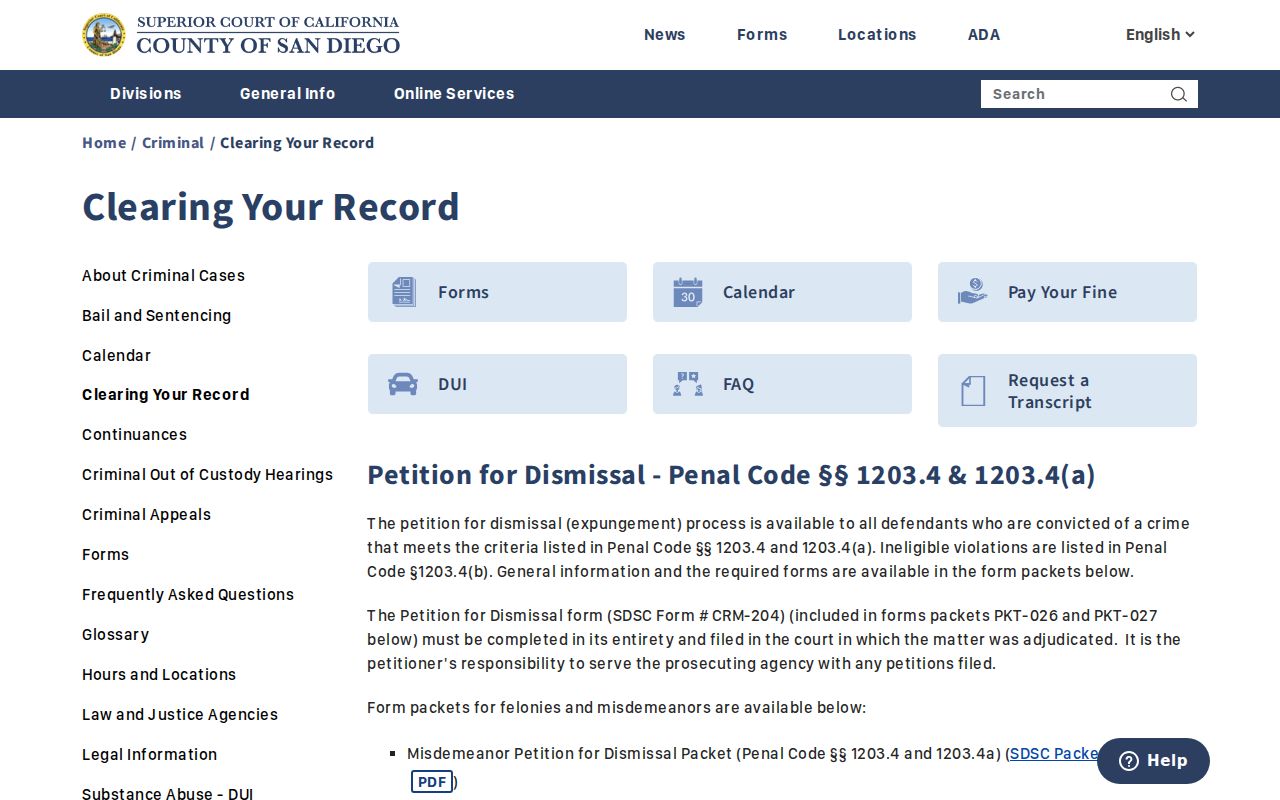
Its separate procedures show why the exact case outcome and the chosen form both matter before you request any downstream update.
San Diego County Booking Record Archives
SDSO does not publish how long it keeps a county booking photograph, electronic booking record, or inmate jail jacket. County records-management audits confirm the Sheriff uses retention schedules and maintains controlled paper and electronic jail-jacket records, off-site storage included. The public audit never states the duration. Online roster visibility and internal agency retention are different questions. A narrow public-records request for the current schedule entry, trigger, and final disposition is the sound next step.
Old San Diego County bookings do not transfer automatically to the California State Archives. The Archives does hold historical state-prison material, including Folsom and San Quentin photograph collections and related registers. Those sets can include a prison number, sending county, crime, sentence, physical description, and image. They cover state-prison commitments, not a full county arrest archive. Older local court files may instead need the relevant courthouse's microfilm path.
Find San Diego County Busted Mugshots
A reliable San Diego County lookup starts with custody status, not with a presumed photo. The official county roster is the best tool for someone the Sheriff currently holds. Chula Vista keeps a separate temporary-holding list. A released person may take a records request. State, federal, and immigration custody each use their own locator, and an active warrant is neither a booking nor proof of present custody.
- For a very recent city arrest, identify the arresting agency and allow for station processing before county intake.
- For current Sheriff custody, search Who's in Jail with at least two letters of both the first and last name.
- For a temporary Chula Vista hold, check CVPD's live city listing before assuming a county transfer.
- For a past or released booking, request the booking record from SDSO and the arrest report from the arresting agency.
- For later proceedings, locate the case in the Superior Court Index and inspect the clerk's official file for disposition.
- For state prison, federal prison, or immigration detention, use CDCR CIRIS, BOP, or ICE based on the authority that holds the person.
If a photo is the goal, expect the Sheriff's routine withholding policy. Selective wanted releases may carry a face image for an immediate public-safety need, but those releases are not a complete booking gallery. Check official custody and court sources first. News reports and unofficial publishers come after, never before.
When San Diego County Bookings Appear
Real work happens before a name lands in Who's in Jail. The Sheriff's official booking and classification guide allows up to four hours of interviews and paperwork at the police station before transport even begins. So an empty search can simply mean the process has not caught up. Once the person reaches county jail, staff handle intake, identification, medical screening, and classification before anything posts.
If nothing shows, wait and try again. Check the spelling too, or call the arresting agency. Someone in Chula Vista might still be sitting on that city's temporary holding list. In Oceanside, transport usually points toward Vista Detention Facility. Timing drives the delay. No fixed rule promises when or where a name will surface.
Where San Diego County Mugshots Appear
Photos are the tightest bottleneck in San Diego County's otherwise broad public-records setup. Start with the official custody and court tools, since they tell you who holds the record and what stage a case has reached. Local news adds selected images tied to particular stories. Unofficial publishers sit at the end of the chain, and anything they show deserves a check against an official source.
| Channel | Photo? | Status and access |
|---|---|---|
| SDSO Who's in Jail | No routine photo | Official current Sheriff custody, searched by partial first and last name. |
| SDSO wanted releases | Sometimes | Official, selective public-safety releases, not a full warrant or booking list. |
| Arresting agency records | Request only | Official report path; any image remains subject to agency exemptions and policy. |
| CDCR CIRIS and photo request | Separate request | Official state-prison route, not a county booking lookup. |
| Local news | Story-specific | Times of San Diego Crime, television stations, the Union-Tribune, and Patch Crime & Safety use selected scenes, agency images, or other editorial art. |
| Mugshots.com | Historical thumbnails | Its unofficial San Diego County archive appeared to end in 2016 and is not a recent source. |
| Local Crime News | Text-led | The unofficial SDSO agency page claims daily updates, but city labels and alleged charges need official verification. |
| Other major directories | No local source verified | Busted Newspaper, RecentlyBooked, Arrests.org, and Mugshots.zone had no verified current San Diego County section on the research date. |
Several outlets carry local crime coverage worth scanning. The San Diego Union-Tribune, NBC 7, ABC 10News, CBS 8, and FOX 5/KUSI cover the county, while East County Magazine and the San Diego Reader add neighborhood flavor. Each has its own pace and patch of the map. An image in a story might be a scene photo, a surveillance still, courtroom art, or an agency handout rather than a booking photo, and none of these outlets serves as a full county feed of new arrests.
Search San Diego County Jail Records
The official SDSO Who's in Jail roster lists people held in Sheriff custody right now. It is not a log of everyone arrested. Searching takes at least the first two letters of both the first and last name, plus a CAPTCHA, and clicking a last name in the results opens the detail record.
| Search or result field | Requirement and use |
|---|---|
| First name | Enter at least two letters; partial spelling can help when the full spelling is uncertain. |
| Last name | Enter at least two letters; inspect similar-name matches with care. |
| CAPTCHA | Required to submit the public query. |
| Linked last name | Opens the custody detail for a possible match. |
| Facility and charges | Shows current location and booked charges when available. |
| Court and release | Can show the next court date and a projected release date when known. |
That detail record matters more than it looks. The booking number unlocks VINE notifications and any later records request. Common surnames call for care, so match birth dates and other lawful identifying facts before drawing conclusions. The roster reflects custody, not the court's final word on a case, so legal work needs the court file itself. The official Sheriff's roster capture below shows the current-custody search screen.
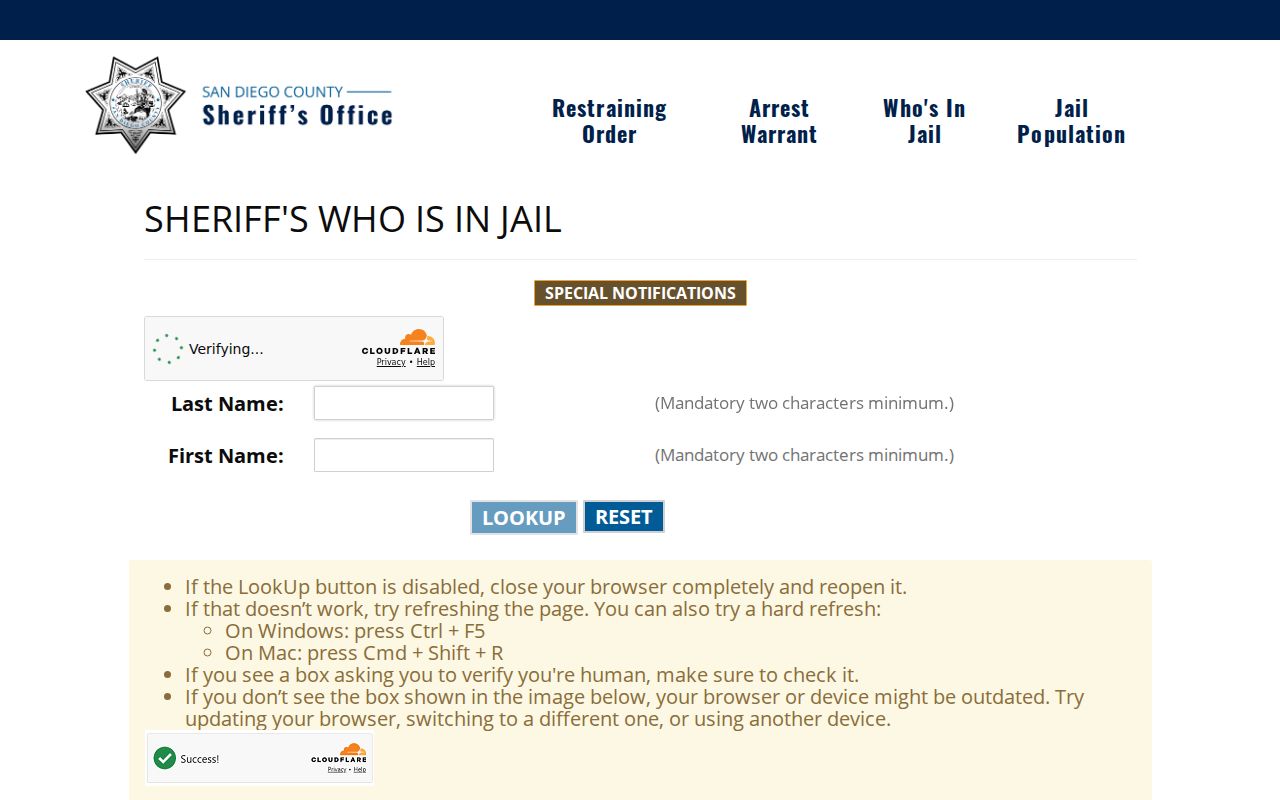
Empty name fields and a CAPTCHA gate tell the story. This interface was built for checking one person at a time, not for browsing a feed of recent bookings.
Busted Mugshots Withheld by SDSO
SDSO draws a hard line on booking photos. Who's in Jail can surface arrest facts, facility, court dates, and projected release information, yet the ordinary booking image stays withheld. The Sheriff's Media Guide treats booking photographs as non-releasable unless releasing one helps capture or warn the public about a dangerous wanted person still at large, and a separate policy statement grounds any release in immediate public safety. That split explains a lot. A valid custody result can come back with no mugshot at all, while a selective wanted bulletin shows a photo the standard roster never would.
Penal Code § 13665 piles on separate limits for law-enforcement social media posts and generally requires qualifying images to come down after fourteen days unless an exception applies. Social posting, website custody data, and agency file retention are three different rules. Keep them apart.
Note: The absence of a roster photograph reflects local release policy and does not show whether an intake image was created.
San Diego County Roster Timing
How often does Who's in Jail refresh? The Sheriff does not say. Claims of "real time" or "hourly" updates have no support for this portal. The site does go down every Wednesday at noon for roughly thirty minutes of maintenance, but that schedule says nothing about the data cycle. One more wrinkle: the interface itself warns that projected release dates can be wrong while being recalculated.
There is no published post-release display window either. So treat the roster strictly as a current-custody tool. Released or transferred people vanish from it, and someone still in police processing has not yet appeared. For an old booking, Records & ID is the route. For an incident report, ask the arresting agency. A search that returns nothing proves only that it returned nothing.
Recent San Diego County Busted Bookings
Want a 24-hour or 48-hour list of everyone booked? The county does not publish one. There is no Sheriff 72-hour archive or weekly booking file either, and Who's in Jail returns only named people still in county custody, so anyone released before your search simply will not show. Chula Vista's list has the same shape, limited to people still held in its temporary city facility.
News releases cannot bridge the gap. They pick and choose incidents. Sheriff calls for service refresh every five minutes, but those are dispatch events, and many never lead to an arrest. Neither source carries the fields, photos, archive, or cadence of a real booking feed, and there is no weekend-surge view for comparing days. The practical chain runs from current custody to an agency records request to a later court lookup.
No. An unofficial page may be stale or incomplete, with timing nobody can verify. Confirm the event with SDSO, the arresting agency, and the court file.
San Diego County Booking Workload
The numbers give a sense of scale. The County's 2024-25 and 2025-26 operational plan counts 50,169 unduplicated bookings and an average daily custody population near 3,971 for 2023. A 2025 CLERB report puts new bookings at roughly 150 to 400 per day across San Diego Central Jail, Las Colinas, and the Vista booking facilities.
Think of these figures as a gauge of how hard the system is working. The jail books a lot of people. That volume says nothing about whether any unofficial roster is complete, though. It is not a live head count. It is not a daily public feed of everyone in custody. A busy booking desk simply means busy.
San Diego County Custody Search Paths
Once someone leaves the county roster, the next database depends on where they went. State prison is the usual stop. A sentenced prisoner can show up in the California Department of Corrections and Rehabilitation CIRIS search. Type a last name or a CDCR number. The system refreshes daily. Results may include the person's name, CDCR number, age, current location, commitment counties, admission date, and parole-hearing details. Photos are the one gap. No image appears there at all. To get a state-prison picture, you must file a media-policy request with CDCR at opec@cdcr.ca.gov, though safety or investigative rules can block it. Even if released, that shot is not the county booking photo from San Diego. The official CIRIS capture below shows the state search source.
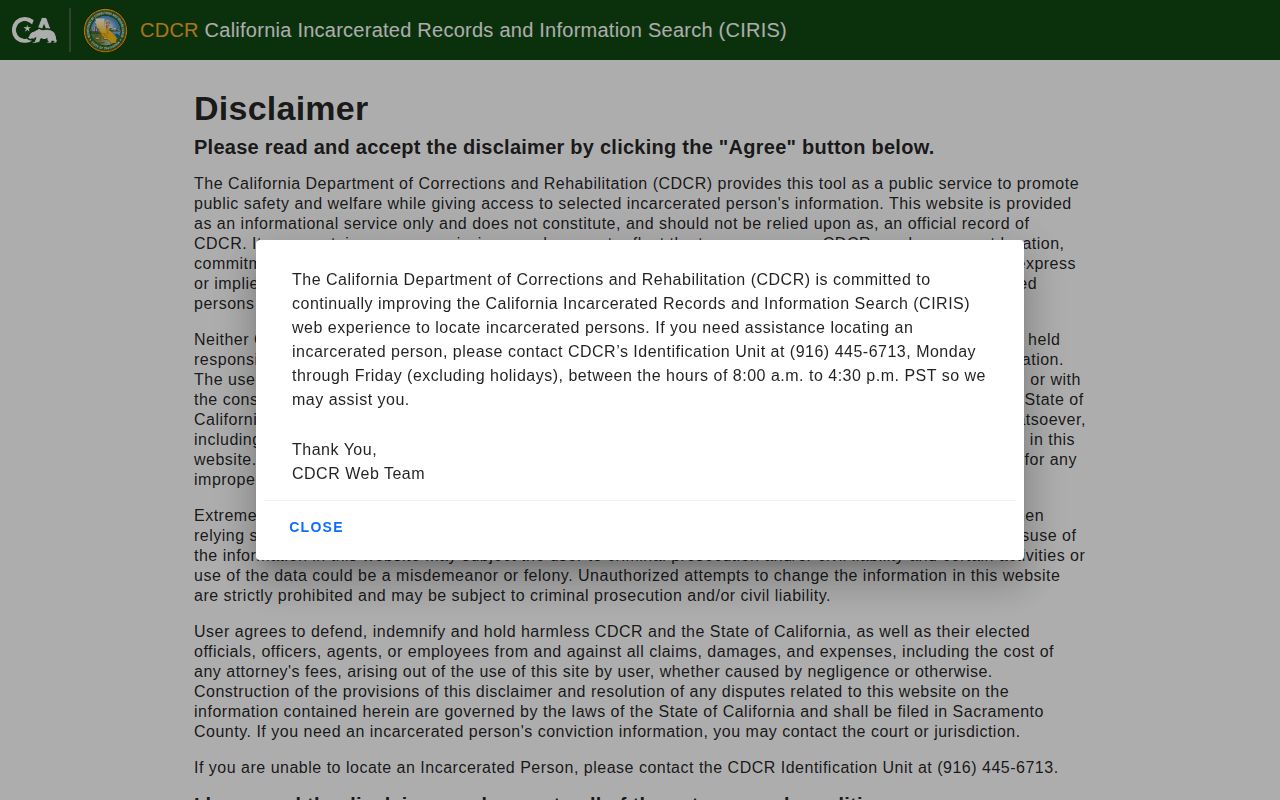
One detail stands out on the search screen. A later state commitment uses its own identifier, so it needs a separate lookup from a current San Diego County booking. The interface makes that split plain.
- Booking
- Intake into custody, when identity, charges, and related records are entered.
- Arraignment
- The first court stage where filed charges and rights are stated and a plea is taken.
- Disposition
- The way the court case ends, such as dismissal, plea, trial result, or another resolution.
- Detainer
- A request or hold tied to another authority; it can change the next custody path.
- Sealing
- A legal restriction on public access to qualifying records, with defined exceptions.
Federal custody works differently. The Bureau of Prisons locator has no public photo field at all. Immigration detention runs through the ICE Online Detainee Locator. That tool asks for an A-number plus country of birth or other biographical facts. A transfer out of county custody can therefore make someone vanish from the Sheriff roster while opening an entirely new ICE search path.
San Diego County Busted Notifications
No inmate lookup or mugshot app exists for SDSO. The JoinSDSheriff product is a recruiting tool, not a custody resource, so don't confuse the two. For notifications, VINE and VINELink do the real work. Sign-up can start from a Who's in Jail detail page, through VINELink itself, or by calling 877-411-5588. Bring the booking number if you have it. The Sheriff recommends that identifier above all others.
VINE costs nothing and keeps your name out of it. Registrants get alerts on release, scheduled release, or a transfer to another county or state prison. Booking images and court outcomes are outside what it reports. Plenty of other channels carry public-safety news, including Sheriff announcements, Nixle, newsletters, helicopter notices, Genasys Protect, and AlertSanDiego. Not one of them offers a steady feed of recent arrests, though.
Note: Custody notification tracks a person's status in a system; it does not explain the filed charges or final court result.
North County Busted Booking Route
Vista Detention Facility sets the North County path apart. It opened in 1978. It is the only booking jail north of the city, logging roughly 13,660 bookings a year. County materials note long-range modernization planning for a building nearing fifty years of service. After an arrest in Oceanside, Vista is the sourced ordinary intake stop for adults of both sexes, pending acceptance and classification.
Geography matters for searchers. An Oceanside busted lookup should not start at San Diego Central Jail by default. Once the Sheriff accepts someone into custody, the countywide Who's in Jail portal becomes the public tool. Before that point, Oceanside Police holds the incident or arrest report. A transfer or release can shift the record path again. Vista explains the routing, though it offers no separate roster or photo gallery of its own.
Busted Mugshots by San Diego County City
San Diego, Chula Vista, and Oshawa-sized Oceanside share one county custody system. Yet each big city has its own first stop. The Sheriff's lookup covers everyone once booking happens. Before that, each city's police department is where a report request begins. Follow the city link for its report path, its public log finding, and the likely handoff to county booking.
- San Diego Busted Mugshots: San Diego Police holds the arrest report, while accepted county detainees commonly enter through San Diego Central Jail or Las Colinas, with placement subject to classification.
- Chula Vista Busted Mugshots: CVPD has a live temporary-holding list before transfer to a Sheriff jail or another appropriate facility.
- Oceanside Busted Mugshots: Oceanside Police holds the city report, and Vista Detention Facility is the sourced North County booking site.
No city agency here posts a complete historical mugshot feed. Countywide news outlets run selected story images. Unofficial sites may lag or miss cases entirely. Verify with the official agency or court before relying on anything.